


At a Glance
- Strategic Liquidity Tool: Continuation vehicles have evolved from a niche solution in private equity to a mainstream tool to address liquidity needs and maximize portfolio value across all private asset classes
- Unrealized Value Catalyst: Top performing private credit funds often retain significant unrealized value later in their lifecycles, positioning continuation vehicles as an efficient solution to release liquidity while preserving exposure to performing assets.
- Market Momentum: Continuation vehicles represented 65% of total credit secondaries volume in H1 2025 and are poised for continued growth.
The Evolution of Continuation Vehicles
A continuation vehicle (“CV”) is a newly formed investment fund that allows a general partner (“GP”) to transfer assets into a new structure to extend the investment horizon while offering liquidity to existing limited partners (“LPs”).
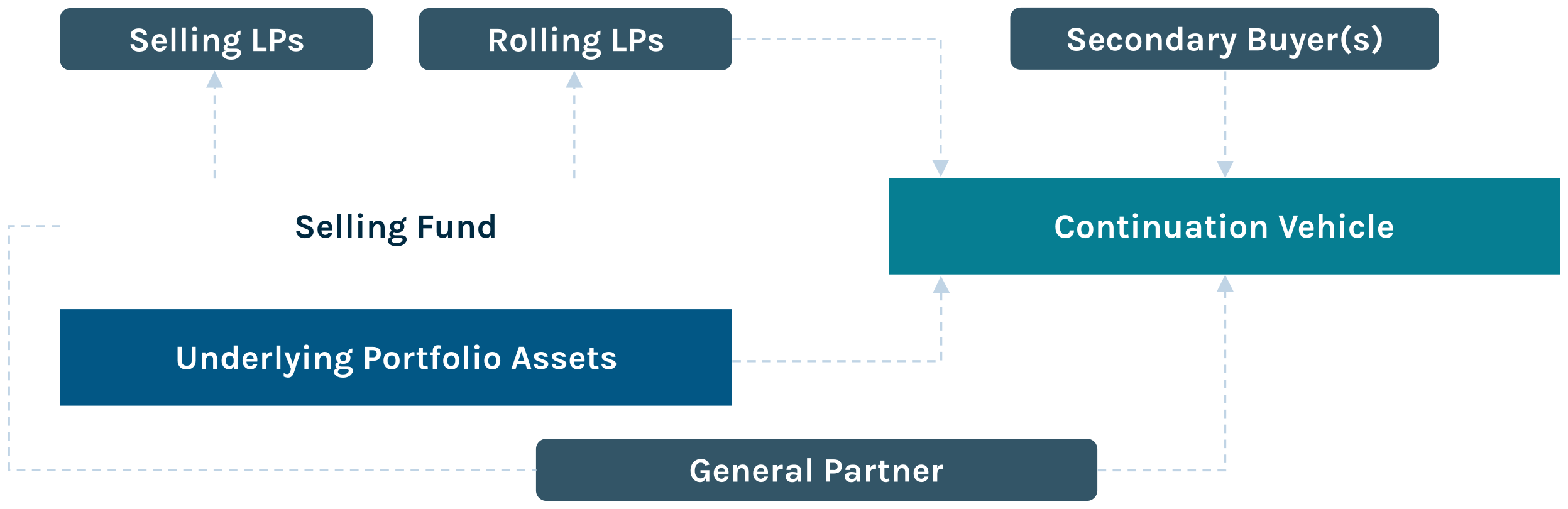
When forming a CV, LPs are typically given the option to either cash out (receive their share of net proceeds) or roll their interest into the continuation fund. The GP typically contributes capital (through rolling any crystallized economics and in some cases, additional new GP commitment) to support the transaction alongside the secondary buyer. Assets are then contributed into the newly established continuation vehicle, where the GP, secondary buyers and any rolling LPs become the new investors. The process is typically facilitated by an appointed advisor and priced through a competitive process.
Continuation vehicles were originally used by more established secondary asset classes, such as private equity, as a solution to address hard-to-exit positions, and have since evolved into a strategic liquidity tool—allowing managers to hold high-performing assets for longer, align incentives, and preserve upside. As traditional exit paths have stalled and DPI ratios compressed, CVs are becoming an attractive solution for liquidity management. Today, they represent a core component of the secondaries ecosystem, with CVs comprising nearly half of the $160 billion total secondary transacted volumes in 20241.
Adoption in Private Credit
Trends from private equity and other scaled asset classes are increasingly shaping the credit secondaries market, leading to an accelerated adoption of continuation vehicle transactions as the market embraces the same technology.
Private credit funds’ structure—typically built around an eight-year term and four-year investment period with recycling provisions—means many funds still hold significant unrealized value towards the end of their life.
This dynamic, paired with years of muted M&A and refinancing activity, has led to slower Distributions to Paid-In Capital (“DPI”) progression in many private credit funds, despite the attractive returns and yields of these strategies. As shown in the chart below, we estimate 2019 vintage private credit funds to have an average DPI multiple of ~0.6x, indicating that only 60% of invested capital has been returned to LPs to date2.
Continuation vehicles offer a strategic solution for both GPs and LPs: unlocking liquidity for LPs, enabling GPs to partner on new opportunities, and extending exposure to performing portfolios—enhancing both capital efficiency and return potential.
Private Credit DPI Multiple by Vintage3
Additionally, CVs may offer strategic fundraising advantages. In this environment, proactive liquidity planning is essential. GPs who engage LPs early—offering CVs as part of a broader liquidity toolkit—can strengthen relationships and even catalyze future fundraising. Legacy LPs may choose to re-invest proceeds into a GP’s next vintage, and the process itself—often initiated with a simple indicative price—can spark productive conversations around liquidity.
“Private credit continuation vehicle transactions have been embraced at a significantly faster pace than we have historically seen in other secondary asset classes. The growth in capital formation now enables GPs to adopt this technology at scale and offer a new and attractive liquidity option to their LPs.”
— Luca Salvato, Partner and Co-Portfolio Manager, Ares Credit Secondaries
Market Outlook and Sustainability
CVs accounted for 65% of the ~$9 billion in total credit secondary transaction volume in H1 2025, highlighting their key role in the market4. Beyond frequency, transaction sizes have grown meaningfully driven by increased awareness, strong investor appetite for larger, high-quality portfolios and capital formation by secondary buyers.
Recent GP-led transactions have regularly exceeded $500 million, signaling deep conviction in the performance and scalability of these assets and the sponsors managing them.
“The successful execution of credit continuation vehicles to date has validated the model and sparked broader market interest. We’re now seeing an increasing number of well-regarded private credit GPs bring sizable, high-quality portfolios to market in both the U.S. and Europe.”
— Dave Schwartz, Partner and Head of Ares Credit Secondaries
Our Approach
The Ares Credit Secondaries team has evaluated approximately 30 continuation vehicle transactions year-to-date, with an average deal size of $1.3 billion. A large portion of these transactions provided access to performing, predominantly senior-secured portfolios across North America and Europe, aligning with secondary investor preference for high-quality credit exposure. However, it’s important to be discerning as not all opportunities are created equal and return profiles can vary significantly. Within this senior-focused subset, we’ve observed meaningful divergence in credit quality across portfolios, underscoring the need for rigorous bottoms-up due diligence. We believe that information edge and extensive credit underwriting experience are key differentiators in identifying and analyzing attractive risk-adjusted credit secondaries opportunities.
Select CV Transactions Reviewed5
With strong tailwinds—record dry powder, increased adoption by private credit managers, and upward pricing trend—we expect this momentum behind continuation vehicle adoption to accelerate into 2026 and beyond.
Ares Credit Secondaries
Ares Credit Secondaries was established in 2023 as part of the Ares Secondaries Group, a leader and innovator in secondary markets for three decades across private equity, real estate, infrastructure, and private credit. Ares Secondaries Group manages approximately $38.4 billion in assets as of September 30, 2025.
Ares Credit Secondaries has rapidly grown to $3.8 billion of assets under management and seeks to leverage Ares’ leadership across both credit and secondaries investing. The strategy is focused on investing in leading secondary credit interests with an emphasis on first-lien, senior-secured positions across North America and Western Europe, with a senior investment team with an average of 25 years of credit and secondaries underwriting experience.